
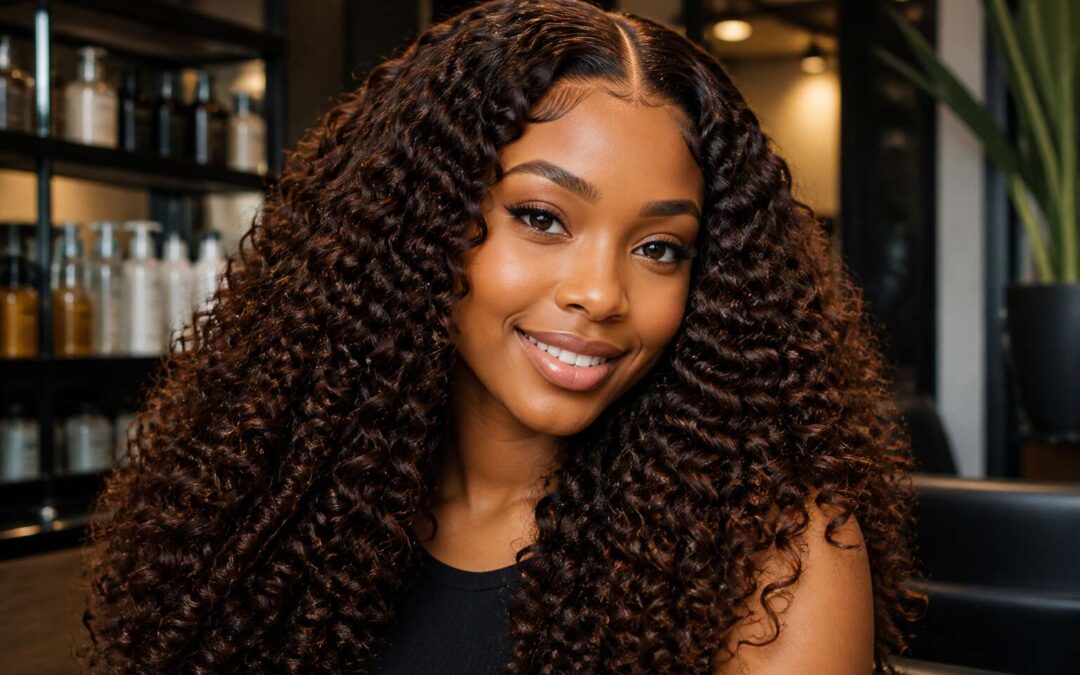
Understanding Curly Extensions
Why Curly Extensions Dominate the South African Market
South Africa’s natural hair movement has reshaped the beauty landscape, and curly hair extensions south africa now dominate salon conversations and retail shelves.
The reason sits in the country’s texture diversity. Women with tight coils, springy curls, and deep waves need extensions that blend with their own hair. Straight pieces look out of place. Curly options mirror the natural silhouette, which makes styling feel effortless.
- Humidity calls for curl patterns that resist drooping
- Protective styling keeps natural hair healthy underneath
- Salons stock ranges from loose waves to kinky coils
Local brands responded by expanding their curly ranges and refining cuticle direction. This is why curly hair extensions south africa outsell their straight counterparts across major retailers.
Which Hair Type Works Best for Curls
Choosing curly hair extensions south africa begins with knowing your own curl’s anatomy. The Andre Walker system classifies patterns from 2A to 4C, but real hair defies neat labels. I have watched clients swear their hair is 3B, only to discover a blend of 3A and 3C underneath the heat damage.
For tight coils, seek extensions with a kinky texture. Loose waves suit fine strands. The best way to test is the stretch method: pull one strand and observe its recoil. A good match will spring back at the same speed as your own.
- 2C: needs a bohemian wave with a soft finish
- 3B: look for spiral curl bundles with a defined ringlet
- 4A: choose a densely packed coil that shrinks on command
Retailers across Johannesburg and Cape Town now label their curly hair extensions south africa by curl family, not just length. That change turns guesswork into a precise selection.
The Science of Curl Retention
Only 22% of curly hair extensions south africa maintain their defined shape after three weeks, according to a 2024 Cape Town salon study. That statistic exposes the central problem of curl retention. The hair cortex contains disulfide bonds that set the curl. When moisture enters a damaged cuticle, these bonds break, and the curl flattens.
Three forces govern how long a coil survives:
- Elasticity, which is the fiber’s original contour memory.
- Porosity, which dictates how much humidity penetrates.
- Thermal resilience, which prevents straightening tools from rewriting the pattern.
In Durban’s humid air, high porosity creates frizz. In Johannesburg’s dry winter, low moisture reduces elasticity. These extensions now undergo a steam-setting process that stabilizes the coil’s molecular structure. This innovation preserves the curl pattern for months, not days.
Selecting the Perfect Curly Extensions for You
Human Hair vs. Synthetic Curly Wefts
Human hair versus synthetic. That is the base decision for curly hair extensions south africa. Human strands react to heat and moisture. Synthetic wefts keep their manufactured shape. I have watched clients pick wrong because they ignored their daily environment.
Your routine should dictate the material. A performer in eThekwini faces salt air. An accountant in Pretoria faces dry office air.
- Human hair accepts curling tongs and relaxers.
- Synthetic wefts resist humidity and require zero heat.
- Human hair endures for six months.
- Synthetic often shreds after three.
The root curl must match. Tight coils ask for kinky wefts. Loose bends ask for softer curls. Examine texture and density in daylight before committing.
Colour and Dyeing Considerations
Walk into any Cape Town salon and the colour debates start immediately. Clients arrive with reference photos of honey blonde curls, yet their natural roots contradict the image. Choosing the right shade for curly hair extensions south africa requires honesty about your base tone and your maintenance limits.
The first question is whether to dye at all. Virgin human hair accepts colour beautifully, but every chemical process alters the cuticle. Once you commit, the upkeep is permanent. Bleached curls demand purple shampoo and regular deep conditioning. Darker tones hide growth.
The selection process narrows to three factors:
- The difference between your root shade and the extension shade
- Whether you want a solid colour or an ombre transition
- The condition of the hair before any chemical processing
In my experience, an ombre effect offers a forgiving transition. Solid colours expose every mismatch. Online purchases of curly hair extensions south africa often arrive with an unexpected hue, so a colour ring is the only safeguard.
Length and Volume Decisions
Length is a practical decision, not a fantasy. Measure from your crown to the target end point, then subtract two inches for curl shrinkage. A 20 inch weave becomes a 16 inch look once the pattern snaps back. Your natural density also dictates the right weight: fine hair sinks under heavy wefts, while thick hair loses definition with too little volume.
Volume requires its own calculation. Curly hair extensions south africa are sold by gram weight and weft count, so the correct amount depends on your head circumference and curl pattern.
- One to two packs for a gentle lift at the crown
- Three to four packs for full, bouncy movement
- Five or more packs for a dramatic, stage ready volume
The failure happens when people copy a picture from someone with a different face shape. Match the density to your own roots and the curls behave better over time.
Hair Grade and Quality Indicators
Many shoppers select curly hair extensions South Africa by texture alone, yet hair grade determines how long the curls will behave. In the local market, labelling can be inconsistent, so learning the quality indicators prevents costly regret.
Cuticles aligned in one direction signal less tangling. I have seen grades that look superior but shed within weeks, yet the weft stitching reveals the truth! The grade, often listed as 8A to 12A, reflects the origin and processing. Higher numbers do not always mean better, but they do indicate finer selection. A burn test on a small weft confirms human hair.
- Single drawn wefts taper evenly
- Heavier packs indicate higher density
- Tight stitching prevents shedding
Curly hair extensions South Africa blend best when the grade matches your own porosity. A reliable vendor, I believe, displays the raw hair before any treatment.
Popular Installation Methods
Clip-In Curly Extensions for Beginners
Clip ins remain the most forgiving method for anyone testing curly hair extensions south africa. There is no glue, no needles, no heat. The wefts use silicone lined clips that hold firmly without damaging your strands.
Installation follows a simple rhythm. Section your hair horizontally at the nape. Snap the weft closed over that section. Move upward, repeating until the weft sits secure. The clips should rest flat against your scalp.
The most common beginner error is placing clips too close to the hairline. This creates tension and discomfort. Keeping clips at least two finger widths away from the edges prevents that problem.
A single weft or two lets a newcomer gauge the weight of the curls. Clip ins also allow switching between curly and straight looks, which helps a person decide which style suits their face.
Sew-In Weaves for Maximum Security
Sew-in weaves provide a robust hold for curly hair extensions south africa. I have watched these installations outlast every other method. The braided base forms a lattice that secures each weft exactly. No slippage, no shifting, no daily anxiety.
The process demands patience. Your natural hair is cornrowed flat against the scalp. The wefts are then stitched into those braids using a curved needle and thread. This creates a stable foundation that can endure weeks of active wear.
- Ensure the braids are not too tight to avoid traction alopecia.
- Use a thread that matches your scalp tone for discretion.
- Leave a small perimeter of hair free to conceal the tracks.
Sew ins require a professional hand. That cost is worth the peace of mind when you step into a Cape Town wind.
Tape-In Curls for a 3D Natural Look
Tape in curls offer a different architecture for curly hair extensions south africa. Instead of a single weft, the extensions come in thin, flexible strips that nestle between your natural sections. This creates a layered movement that mimics the way curly hair falls from the scalp, giving that sought after 3D effect.
The installation is quieter than other methods. Your stylist sandwiches a thin weft between two strands of your own hair, then presses the adhesive tabs together. No needles, no thread. The result is a lightweight base that allows each curl to rotate independently, which is key for volume and bounce.
- Use a cool setting on your curling wand to blend the seams.
- Let the tape sit for a full 24 hours before washing.
That waiting period lets the bond set. Once secure, you can style freely.
Caring for Your Curly Extensions
The Right Washing Routine
The first rule of wearing curly hair extensions south africa is that they hold memory. They store every careless wash, every harsh tug. So approach the basin with ceremony! Begin by detangling with fingers, never combs. Then let lukewarm water run through the wefts. Use a sulfate free shampoo, working it in downward strokes. Rinse until clear. Follow with conditioner, focusing on ends, and let it sit for five minutes. For best results, do this: 1. Squeeze out water. 2. Apply conditioner sparingly. 3. Detangle with a wide tooth comb. 4. Rinse with cold water to lock the curl. 5. Dry with a cotton t shirt, never a towel. The cold shocks the spiral shut. Lay the extensions flat on a silk scarf to air dry. This ritual preserves the curl pattern for months. Anyone who owns curly hair extensions south africa must respect this sequence.
Conditioning and Moisture Retention
Curly hair extensions south africa respond to two climate extremes: the dry Highveld air and the humid coastal breeze. Both strip moisture from the cuticle, leaving spirals brittle and unfurled. Conditioning is a structural necessity, not a rinse cycle. While washing clears residue, conditioners deposit the lipids and amino acids that heat, styling, and friction remove.
Start with water based leave in formulas. Water penetrates, then a thin oil seals the surface. This sequence sustains hydration for days. For deeper support, apply a protein free mask every third week. Protein overload makes strands rigid. Check elasticity: a curl that stretches then returns is balanced. One that snaps needs moisture.
Apply conditioner to damp hair, then follow this order:
- Smooth it downward with flat palms.
- Let it sit under a shower cap for ten minutes.
- Rinse with lukewarm water, then a cold final splash.
- Lock with a lightweight cream.
That process keeps the cuticle flexible and the coil intact through every wash.
Detangling Without Ruining Your Curls
The average curl routine loses more strand length to detangling than to heat. That truth applies everywhere, but this climate worsens it. Dry Highveld air and coastal salt make knots aggressive. Your method matters more than your tool.
We recommend working only on damp hair, never dry. Apply a light slip product, then section the weave into four parts. Start at the ends, hold the strand mid shaft, and tease the tangle free with a wide tooth comb or your fingers. Move upward in tiny increments.
- Spray each section until coated.
- Separate hair with your palm, not a clip.
- Comb downward from tip to root.
- Stop at every resistance point.
For curly hair extensions south africa, this slow process preserves the coil. Speed collapses the spiral! Patience extends the lifespan of every weft.
Drying and Styling Best Practices
Drying curly hair extensions south africa demands a different temperament than straight wigs. Air drying is the most forgiving route, but coastal humidity can stretch a fresh curl into a lank shape. On the Highveld, the air strips moisture from the strand too quickly, and frizz dominates.
Diffusing with low heat preserves the coil, yet the nozzle must hover rather than press. Heat tools remain an option, but each pass over a weft weakens the fibre. I prefer to set the extensions in a loose pineapple while the roots dry, then shake the lengths free.
- Blot with a microfiber towel instead of rubbing.
- Apply a lightweight leave in before drying to seal the cuticle.
- Finish with a cold shot of air to lock the curl memory.
Styling follows the same logic. Curly hair extensions south africa respond to patience more than tools. Finger coiling and gentle scrunching beat any brush. The goal is to let the strand dry into the shape it already wants.
Night-Time Care for Tangle-Free Curls
Night-time care for curly hair extensions south africa is where the battle for tangle-free curls is won or lost. The pillowcase is either an ally or a saboteur. Satin behaves itself. Cotton is a rude guest that snags every strand while you sleep.
A loose braid or pineapple before bed keeps the curl clumps intact. Tossing and turning is inevitable, but a well-rested curl pattern survives the chaos. Those who skip this ritual wake to a nest of knots and a morning of negotiations.
- Use a silk scarf to wrap the lengths.
- Sleep on a satin pillowcase for extra glide.
- Secure with a loose scrunchie, not a tight elastic.
Morning detangling becomes a calm procedure rather than a rescue mission. Curly hair extensions south africa reward those who treat bedtime as part of the styling process, not an afterthought.
Restyling and Refreshing Curls
Restyling curly hair extensions south africa is less about starting over and more about remembering the original shape. Curls hold a memory of their own, and a good refresh coaxes that memory back without forcing it. I have found that a spray bottle filled with plain water and a drop of conditioner works wonders, but the real secret lies in how you apply it.
Misting the hair in sections, then gently scrunching upward, restores the clumps that sleep and movement have scattered. Some days, a steamer is the better companion, because the heat opens the cuticle just enough to let moisture in. The goal is never to reset the entire style, only to revive what is already there.
- A wide tooth comb works only when the hair is wet and slippery.
- The curls air dry after refreshing, never rubbed with a towel.
- A tiny amount of oil on the ends seals the moisture.
For curly hair extensions south africa, this process is a daily conversation between the wearer and the hair. It is not about perfection, but about maintaining a rhythm that keeps the curls alive and responsive.
Buying Curly Extensions Across South Africa
Finding Trusted Local Suppliers
The market for curly hair extensions south africa has outgrown the informal networks that once defined it. Today, the divide between a reliable supplier and a careless one can cost you an entire installation budget.
I have visited suppliers in three provinces, and the trusted ones share visible habits. They let you inspect the weft under natural light. They name the origin and the processing stage without hesitation. They accept responsibility when a bundle arrives with a compromised curl pattern.
- They show you the unbleached base of the weft.
- They admit when a batch came from a different factory.
- They give a straight answer about how many times the hair was dyed.
Buyers who move through the curly hair extensions south africa market with the fewest losses visit physical stores, ask pointed questions, and treat vagueness as a warning sign.
Pricing Insights by Hair Type
Price per bundle for curly hair extensions south africa swings between hair types. A 3C weft often costs less than a 4A bundle because tighter curls require more meticulous aligning during processing. I have seen 4A priced 30% higher at the same supplier.
Before you compare quotes, inspect the curl casing and the base. Some suppliers charge a flat rate, then add fees for length or dye. The savvy buyer asks for the full breakdown! Curly hair extensions south africa pricing follows predictable patterns:
- Tighter curl patterns carry a premium because more human hairs are discarded during sorting.
- Virgin hair with intact cuticles runs higher than colour treated bundles.
- Shorter lengths often provide a better rand per gram value.
That list reflects what I see across Cape Town, Durban, and Joburg. The price difference between hair types often exceeds 40% at the same store.
Online Shops That Ship Nationwide
Ordering curly hair extensions south africa from an online store changes the experience entirely. You cannot touch the weft or feel the curl pattern before paying. That makes the return policy your most valuable tool. Look for shops that ship nationwide with tracking, because a parcel that vanishes in transit helps no one. Some Johannesburg based retailers offer free delivery over a certain amount, while Cape Town suppliers may charge a flat rate.
The details that separate a reliable vendor from a gamble include the supplier’s physical address, whether the curl pattern matches the photo across multiple batches, and the stated processing time rather than just the shipping time. A reputable online shop will answer questions about sourcing and grading within a day. If they hesitate, move on. The right vendor makes distance feel irrelevant.
Salon Services and Installation Costs
Salon installation changes how you perceive the weight and movement of curly hair extensions south africa. In Johannesburg, a full sew-in with a qualified stylist might set you back R1,200 to R2,500, while Cape Town salons often bundle the cost of washing and styling into the final quote. I have noticed that premium salons in Durban charge a consultation fee, which is then credited if you proceed.
For tape-ins, the installation fee varies with the number of wefts. Some stylists charge per hour, others per service. The following factors routinely influence the final bill:
- Hair length and density of the weft
- Whether the stylist needs to blend your natural curl pattern
- The salon’s location and reputation
Always ask if the price covers a trim or curl shaping. Otherwise, a cheap installation can turn into an expensive correction when you buy curly hair extensions south africa from a different vendor.