
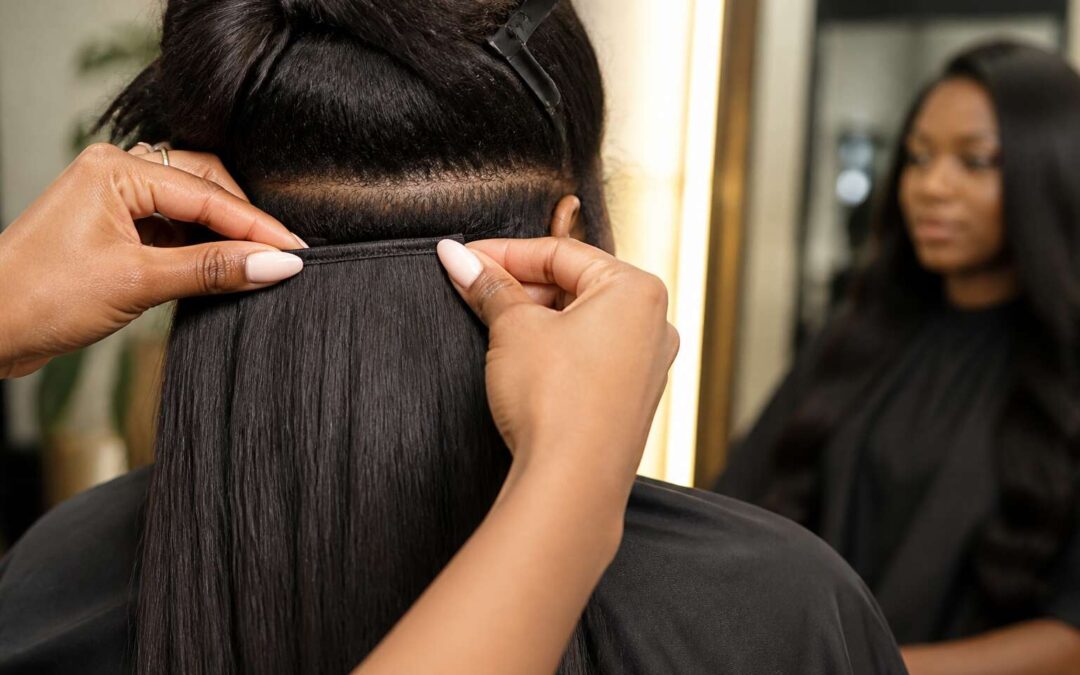
The Basics of Hair Extensions
What Are Hair Extensions Made Of?
People often assume hair extensions are one product. The reality is more complicated. At their core, extensions are strands of fibre attached to your natural hair to add length or volume. The material largely determines price and durability.
Human hair extensions come from donors, often sourced from temples in India or Brazil. These strands keep their cuticle intact, which means they tangle less and last longer. Synthetic options use plastic fibres like modacrylic, which mimic shine but cannot handle heat styling. Some blends mix both.
Common materials include:
- Remy human hair with aligned cuticles
- Virgin hair with no chemical processing
- Synthetic waxed or coated fibres
How do hair extensions work in practice? The attachment method, whether tape, glue, or micro rings, matters, but the fibre quality sets the ceiling. I have seen cheap synthetics shed within weeks, while good human hair can survive months.
How Extensions Attach to Natural Hair
A stylist can transform a client in under an hour, but the real question is not what the hair is made of. It is how the extension stays attached. The system used decides how long extensions last, how often maintenance is needed, and whether natural strands survive.
The principle is simple. Natural hair must be clean and isolated before any piece is placed. Oil, product buildup, or loose sections will compromise the bond.
Common systems:
– Tape wefts sandwich your natural hair between two adhesive strips
– Micro rings clamp a strand of extension hair to a section of your own hair
– Sew-in weaves braid the natural hair and stitch the weft to the braid
– Fusion bonds attach each strand with a keratin tip
Weight distribution changes with each method. Tape and micro rings sit flat and discreet. Weaves need more coverage. Fusion bonds require solvent for removal. Understanding how do hair extensions work with your specific texture starts with a proper scalp check. Even the best hair fails when anchored poorly.
The Science Behind Bonding and Tension
Hair extension science is a quiet negotiation between grip and give. Too strong a bond respects nothing; too weak a bond respects even less. What keeps a client comfortable is the rate at which tension disperses across the scalp, and that rate rarely appears on any label.
The cuticle’s natural reaction to moisture is the first principle. When damp, strands expand. When dry, they contract around the bond device. This microscopic movement, repeated daily, creates the wear patterns that either preserve or pulverise the root. Specialists call this the “breathing window.”
- The bond’s shape dictates pressure points
- The hair’s wave pattern alters force direction
- The wearer’s sleep routine shifts stress overnight
How do hair extensions work? They work through a delicate ratio of adhesive strength and living tissue allowance. Each adjustment alters that ratio, which is why maintenance is an art, not a service.
Different Application Methods Explained
Clip-In Extensions: Temporary and Easy
When I first placed a weft against my scalp, the tiny combs held firm. Clip in extensions answer the question of how do hair extensions work with a refreshingly simple method. There is no adhesive, no heat, and no prolonged waiting. You section your hair, snap the clips shut, and the transformation happens in minutes!
The main appeal is reversibility. You can wear them for a single evening or a whole weekend. Unlike permanent systems, they release with a simple press. This reduces the worry of long term commitment.
- Section the hair horizontally at the nape of the neck.
- Open the clip and slide it close to the scalp.
- Press the clip shut until it feels secure.
For someone in South Africa exploring options, clip ins show how do hair extensions work without permanent alteration.
Tape-In Extensions: Semi-Permanent Adhesion
Tape-in extensions adopt a quieter approach. A medical-grade adhesive laminates the weft to a thin slice of your natural hair, creating a flat union that sits discreetly against the scalp. I have watched clients forget they are wearing them entirely. This semi-permanent system rewards patience and routine.
The process is precise. A stylist sections the hair, then sandwiches each tape weft between two fine layers of your own strands. No heat, no heavy tools. Just measured pressure. This is how do hair extensions work for anyone who desires fullness without the nightly ritual of clip-ins.
A few notes for the uninitiated:
- Use sulfate-free shampoo to preserve the adhesive.
- Brush from the ends upward to avoid stressing the bond.
South African humidity can test any bond, so schedule your six to eight week maintenance faithfully. Tape-ins offer longevity between clip-ins and fusion, a balanced option for those who want commitment without permanence.
Sew-In (Weave) Extensions: Braiding and Threading
Sew-in extensions operate on a woven logic. A stylist braids your natural hair flat against the scalp into sturdy rows, then threads wefts of extension hair onto that foundation with a curved needle. This method demonstrates how do hair extensions work when you need weight distributed evenly and no adhesive resting against your skin.
The system holds a loyal following in South African salons. Humidity, heat and gym sessions do not loosen a stitch. The braids carry the load, which keeps tension off your own strands.
- Flat braids, never tight enough to pull.
- Wefts positioned below the occipital bone for a natural drape.
- Maintenance every four to six weeks prevents matting at the root.
I have watched sew-ins hold their shape for months when those rules are respected. The thread does the persuading, quietly.
Fusion and Bonded Extensions: Keratin Adhesives
Fusion extensions take a different route entirely. Instead of threading wefts onto braids, a stylist melts a keratin adhesive and bonds each extension strand directly to a small section of your natural hair. The keratin hardens into a tiny, discreet bond that rests a few millimeters from the scalp.
This method shows how do hair extensions work when you want total freedom in styling. No tracks, no thread, no adhesive strips. Individual bonds move naturally with your head, so you can tie your hair up, part it anywhere, or wear an elaborate updo without exposing the attachment points.
– A full head typically requires 100 to 150 bonds.
– Each bond fuses one extension strand to one natural strand.
– Bonds last roughly three months before your hair grows out.
The adhesive holds firm through Johannesburg humidity, but it demands discipline. Sulfate-free shampoo, careful brushing, and regular maintenance appointments keep the bonds from slipping or matting.
Micro-Link (Bead) Extensions: No Heat or Glue
Micro-links rest on a mechanical principle. A stylist threads a section of natural hair through a metal or silicone bead, adds the extension strand, and crimps the bead shut. No heat, no glue, no keratin. Attachment depends on bead tension.
This raises a question: how do hair extensions work when the goal is reversibility? The bead moves down as your hair grows, and maintenance every six to eight weeks keeps it placed correctly. Removal is straightforward. The stylist opens the bead and slides it off. Your hair remains untouched.
- Installation typically spans two to four hours.
- Silicone-lined beads reduce friction against the scalp.
- Fine hair needs smaller beads to distribute tension.
In Johannesburg humidity, micro-links hold without slipping. The daily ritual matters, and I tell every client: brush with care, choose sulfate-free products, and avoid tugging at the root. The bead stays present in every head movement.
The Process of Getting Hair Extensions
Consultation and Hair Matching
The consultation begins with a frank assessment of your scalp and natural strands. Your stylist will examine texture, density, and the growth pattern to predict how the extension will blend. This step prevents tension damage later. Matching the shade takes skill, as salon lights can distort. Given South Africa’s intense UV, your stylist will check colour under direct sunlight to avoid mismatches. A good match considers roots, mid-lengths, and ends. Here, the stylist will also ask about your lifestyle.
- Daily washing patterns affect adhesive lifespan.
- Heat styling frequency influences fibre choice.
- Hair growth rate determines maintenance intervals.
These details clarify how do hair extensions work for your specific routine. They guide the installation method and aftercare plan, so the extension moves and behaves like your own hair, no matter the climate or activity.
Preparing Your Natural Hair
Most people treat extension day like a spa appointment. Wrong. Your natural hair needs a preparatory ritual before any strand gets attached. Clean hair means sulfate-free shampoo? Actually, for extensions, you want a clarifying wash to strip every trace of oil and product residue. Then a deep conditioner restores the cuticle, because extraction damage is real.
The prep sequence:
- Detangle from ends to roots to prevent micro-tears.
- Air dry or blow dry completely, no hidden damp patches.
- Apply a lightweight sealant to smooth the shaft.
How do hair extensions work depends on this foundation. In Cape Town’s humidity or Joburg’s dry heat, your scalp behaves differently. I tell clients to skip heavy oils for 48 hours before installation. That tiny effort prevents slippage and keeps your natural strands from snapping under the added weight.
Application Time and Steps
Application time depends entirely on the attachment method. Tape-ins take roughly an hour. Micro-links occupy two to three hours. Fusion, with its individual keratin bonds, can consume an entire afternoon. I have watched Joburg clients book meetings right after. Mistake.
The stylist partitions your hair into four quadrants, working row by row from the nape upward. Your scalp registers the accumulating weight before the mirror confirms it. Once the attachments are secured, cutting and layering turn the installation into a wearable style.
- Section the hair into four quadrants
- Apply extensions row by row from the nape
- Cut, layer, and style for a seamless finish
How do hair extensions work under salon conditions? Through this measured sequence, where time matters as much as technique.
Styling and Blending After Application
The real transformation begins once the scissors come out. Extension hair arrives uniform and blunt, while natural hair carries its own layers and quirks. A skilled stylist point-cuts and razors the wefts to mirror those patterns, softening the demarcation line.
Styling after application is careful work. Human hair tolerates heat up to 180 degrees Celsius; synthetic blends melt far earlier. Johannesburg’s dry climate taxes both hair types, so heat protection becomes a daily necessity.
Detangling deserves equal attention because tension concentrates at the attachment points. Brush from the ends upward while holding roots steady. A few conditions shape how the style ages:
- Sleep friction pulls at bonds and loosens anchored wefts over time
- Wet hair tangles faster at the attachment rows
- Colour fades first at the cuticle of blended ends
In my experience, clients who respect these conditions keep installations fresh for the full maintenance cycle. That everyday discipline is how do hair extensions work once the salon chair empties.
How Extensions Work With Your Hair Growth Cycle
The Lifecycle of Natural Hair
Every hair on your head follows a fixed cycle: anagen, catagen, and telogen. Anagen lasts years, catagen is a short transition, and telogen ends with shedding to make room for a new one. This rhythm determines how do hair extensions work, because extensions attach to existing strands, not to the scalp itself.
As your natural hair moves through its lifecycle, the extension remains bonded to the host strand. In my experience, the bond shifts downward with new growth, and the extension stays put until the host hair sheds in telogen.
- Anagen: the extension stays secure as the root pushes upward.
- Catagen: growth stops, but the extension does not move.
- Telogen: the hair releases, and the extension falls with it.
The lifecycle of natural hair dictates that extensions are temporary fixtures. They follow the cycle without changing it. Understanding this partnership is the core of how do hair extensions work.
How Extensions Move With Growth
In the follicle’s quiet factory, your hair is always on a schedule. The extension, however, is a permanent houseguest that refuses to leave until evicted by nature. This is the true mechanics of how do hair extensions work. The bond is a passenger on a moving train, and the track is your own biology. As the anagen phase pushes the root upward, the attachment point travels further from the scalp, creating a telltale gap of regrowth.
The bond’s journey is a slow, deliberate process.
– In anagen, the root is actively dividing, and the extension’s anchor is carried along for the ride.
– In catagen, the follicle prepares for rest, and the bond settles into a static position.
– In telogen, the hair detaches from the blood supply; the extension is evicted with the shedding strand.
This movement acts like a slow-release mechanism. The keratin bond or taped adhesive is not glued to the skin, but to the hair shaft itself. Therefore, the growing process physically separates the attachment from your roots. The elasticity of the strand determines how much tension is tolerated before a breakage occurs. A healthy cuticle ensures the bond holds firm until the telogen phase completes its cycle. For the wearer, this means the integrity of your natural hair is the sole factor dictating the lifespan of the install. We often treat shedding as a nuisance, but in this context, it is the release valve. When the host strand finally falls, it carries the weight of the extension with it, leaving the follicle free to begin a new anagen phase. That is the complete, unglamorous truth of how do hair extensions work.
Maintenance and Adjustment Schedules
Most wearers return for maintenance every six to eight weeks. That is roughly how long the anagen phase takes to push the attachment visibly off the scalp. The schedule is not arbitrary. It tracks the average growth rate of one to one and a half centimetres per month.
During an adjustment, a technician slides the bond or bead upward, repositions the tape, or replaces the keratin anchor. This is where the reality of how do hair extensions work becomes visible. The extension is inert material. Only the host strand is alive, and its cycle dictates when maintenance is due.
Here is a typical adjustment schedule:
- Fusion and micro-link: every 8 weeks
- Tape-in: every 6 to 8 weeks
- Sew-in: every 4 to 6 weeks
Shedding will thin the install over time. Each visit should check for matting and tension points, because a delayed adjustment can turn a secure bond into a breakage risk. That is the practical reality of how do hair extensions work.
Potential Damage and How to Avoid It
Your hair growth cycle is asynchronous. Each follicle grows, rests, and sheds on its own schedule. Extensions attach to the hair shaft, not the scalp. As the strand grows, the bond moves downward. If maintenance is delayed, the extension’s weight hangs from a fragile anchor. That strain can cause breakage or traction alopecia.
To avoid damage, limit tension and follow a schedule:
- Keep the attachment within one centimetre of the scalp.
- Use a soft-bristle brush at the roots to avoid pulling bonds.
- Rotate install methods between cycles.
Shedding is natural. But when an extension is fixed to a shedding strand, the follicle may tear. The key question is how do hair extensions work with your living hair. The answer: they rely on your growth cycle. Your natural strand is the only living component. Respecting its timeline prevents damage.
Removing Hair Extensions Safely
Professional Removal Techniques
Removing hair extensions safely is the final measure of a stylist’s skill. The attachment method dictates the exact approach, and professional removal techniques exist to protect the natural hair beneath the added strands. Tape in wefts dissolve with a solvent, keratin bonds shatter under precision pliers, micro links open with decompression tools, and sew in thread demands careful scissor work.
The professional toolkit often includes:
- Solvent sprays for adhesive wefts
- Keratin crushing pliers for hard bonds
- Micro ring openers for bead attachments
- Fine pointed scissors for braid thread
I have watched clients hold their breath during this process. That tension is unnecessary when a professional handles it. Understanding how do hair extensions work includes knowing how they leave. A careful removal, executed methodically, leaves the natural strands healthier than before the extension was applied!
At-Home Removal Risks
The temptation to remove extensions at home is understandable. Salon visits cost money, and waiting for an appointment tests patience. But the at-home removal risks outweigh any convenience. Cutting tape wefts without solvent pulls at the roots. Pliers meant for other jobs can crush keratin bonds unevenly, leaving hard remnants behind. Micro links tightened with household tweezers often damage the hair shaft.
Understanding how do hair extensions work means respecting their attachment points. Each bond, bead, or seam sits close to the scalp where the natural hair is most fragile. Improvised removal methods stress that junction daily. A wrong snip can divide a strand permanently. An unintended tug can rip hair from the follicle before its natural shedding cycle.
Aftercare for Natural Hair
Nothing quite matches the quiet after a skilled pair of hands has released every bond and bead. The scalp takes its first full breath in months. That relief, however, is only the opening act. The true work begins when you finally see your natural lengths in the mirror, free of wefts and adhesive. Understanding how do hair extensions work means acknowledging that the attachment points have carried extra weight for weeks. The follicles need a reset.
Your immediate care protocol should focus on gentle detoxification. Reach for a clarifying shampoo that targets product buildup without stripping the cuticle completely. Follow with a deeply hydrating mask, but resist the urge to massage it into the roots with vigour. The hair is vulnerable at the follicle opening. Treat it with the same deference you would show a fresh manicure. This is not a time for aggressive scrubbing or hot water.
The strategic application of patience matters more than any expensive serum. Consider the following sequence for the first week after removal:
1. Wash with lukewarm water and a sulphate-free cleanser every three days, not daily.
2. Apply a bond repair treatment to the mid-lengths and ends, avoiding the scalp area entirely.
3. Sleep on a silk pillowcase to minimise friction against the previously protected strands.
4. Allow hair to air dry whenever feasible, as heat styling adds unnecessary stress to weakened shafts.
Time is the most underrated ingredient in this entire equation. The hair has been living in a state of controlled tension, and shedding patterns often shift after removal. You might notice more strands in the drain than usual for a few weeks. That is the natural cycle reasserting itself, not a catastrophe. Keep your next salon appointment focused on a trim to eliminate any split ends created by friction, then let your hair simply exist without manipulation for a while. The goal is not dramatic transformation, but a quiet restoration of strength.